Datacenter · concept study
PNN LightStack
A trillion-parameter model in a single rack, at one token per clock: a billion tokens per second.
A concept study of what PNN makes possible in the datacenter: an optical 3D processor stack in which the model lives in the silicon and every layer computes in one clock cycle.
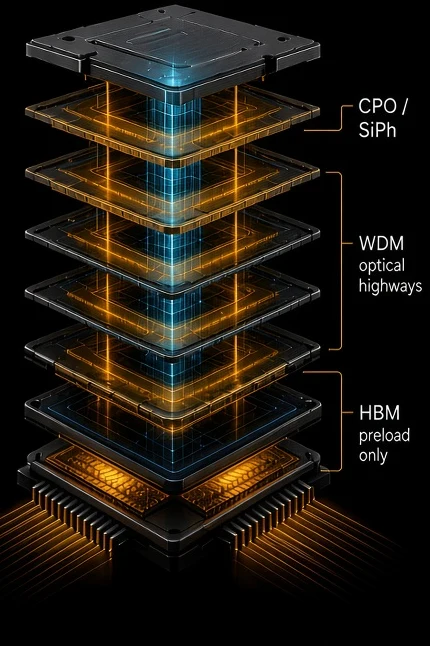
Why a trillion parameters now fit in one rack
- 01
PNN keeps the model small enough for silicon
A dense layer 65,536 neurons wide has 4.3 billion weights. PNN keeps about one connection in ten, structured, with no index stored for them. A trillion-parameter model becomes about 130 billion PNN weights — few enough to be held in the chips themselves instead of being read from memory for every token.
- 02
Every connection has its own arithmetic: one layer per clock
Each connection is wired in silicon with its own multiplier — at 1-bit weights only an add or a subtract. The whole layer computes at once, in one cycle of a 1 GHz clock. No weight is fetched while the model runs, so there is no memory wall to wait on: high-bandwidth memory only loads the weights at start-up.
- 03
Every layer is a pipeline stage: one token per clock
While one token moves on to the next layer, the next token enters the first. A new token starts every nanosecond, so a model runs at 10⁹ tokens per second whatever its size. More layers add latency — 100 ns per stack of 100 layers — not lost throughput.
- 04
Ten chiplets per stack, linked by light
A stack is ten chiplets of ten layers each, stacked in 3D. They talk over wavelength-multiplexed optical links instead of copper: under 0.5 pJ per bit against 1.5–3 pJ for copper through-silicon vias, and 64 waveguides instead of about 524,000 copper connections.
- 05
Three stacks per trillion-parameter model, twelve per rack
Three stacks in a row give 300 layers: a 1.3-trillion-parameter dense equivalent. A liquid-cooled rack holds twelve stacks — four such models side by side, each at a billion tokens per second.
The same model, two ways
Today
A trillion-parameter model in FP8 is 1 TB of weights: more than twelve 80 GB GPUs just to hold it, and every generated token reads the weights again from memory.
PNN LightStack
About 130 billion PNN weights held in the silicon of three stacks, a quarter of one rack; no weights are read at run time, and a token leaves every clock cycle.
Built on measured PNN results: a 1-bit processing element takes 0.17× the area and 0.07× the power of an 8-bit one through place and route, and the generated cores run bit-exact on an FPGA. The PNN models themselves run today on CPUs and GPUs — double your AI capacity now.
Concept study: throughput and latency are design targets, the other figures engineering estimates; none of them is measured silicon. Which number format reaches the targets at a given silicon area is under evaluation, and the accuracy of a trillion-parameter model at PNN density is not yet measured. A billion tokens per second needs many requests in flight, because a sequence's next token waits for its previous one.